

The Emotional Insight of the TMJ: What Your Jaw May Be Holding Onto
When most people think about the temporomandibular joint (TMJ), they think about jaw pain, clicking, clenching, grinding, headaches, or difficulty opening the mouth.
And while these physical symptoms are very real, the TMJ is often connected to something much deeper.
As a TMJ specialist and CranioSacral therapist, I have come to appreciate that the jaw is rarely just a mechanical structure. It sits at the intersection of the nervous system, the cervical spine, the intimate cranial bones, breathing, expression, and emotion.
The jaw is one of the most emotionally expressive parts of the body.
It allows us to speak, cry, laugh, shout, sing, kiss, nourish ourselves, and communicate our needs. It is part of how we engage with the world and reveal who we are.
Perhaps this is why so many people carry tension there.
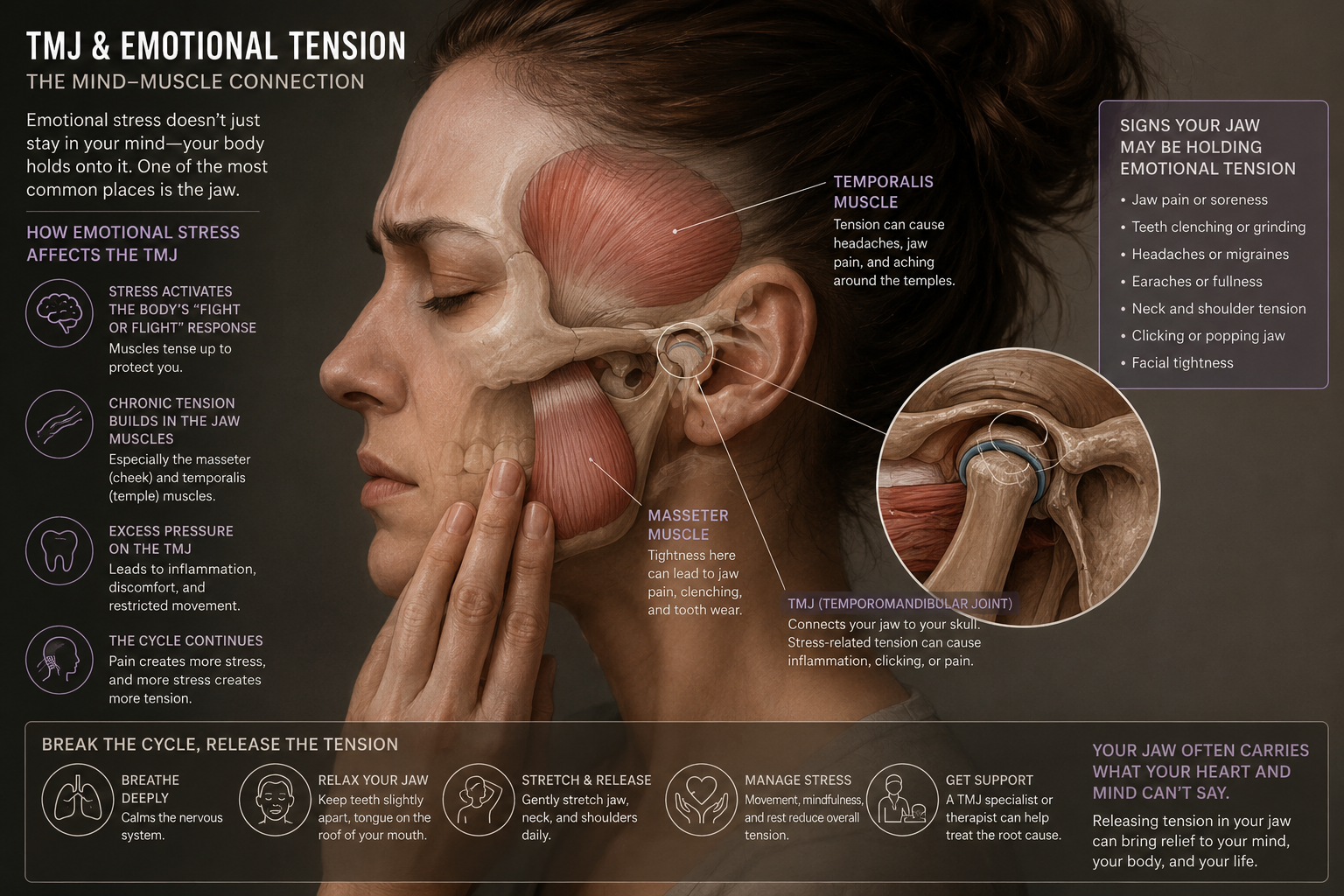
The Jaw: A Gateway to Expression
The jaw is the gateway through which our inner world becomes outer expression.
Every truth spoken, every boundary set, every emotion expressed passes through this region.
But what happens when expression feels unsafe?
What happens when we learn to hold back tears, swallow words, suppress anger, or silence our needs?
The body adapts.
The nervous system is designed to keep us safe, and sometimes safety means holding rather than expressing.
Over time, this holding can become habitual.
The muscles tighten.
The teeth clench.
The tongue presses.
The throat constricts.
The body begins to carry what the voice could not release.
This is not weakness.
It is protection.
The Nervous System and Emotional Holding
The TMJ has a close relationship with the nervous system through the trigeminal nerve, one of the largest cranial nerves in the body.
The jaw is also closely linked to the brainstem, the vagus nerve, and the structures responsible for regulating our stress response.
When we experience ongoing stress, emotional overwhelm, or periods where we do not feel safe, the nervous system naturally shifts into protective patterns.
Many people notice this as:
Jaw clenching
Teeth grinding (bruxism)
Tightness through the face
Neck and shoulder tension
Headaches
TMJ discomfort
Often these symptoms worsen during periods of stress, uncertainty, conflict, or emotional suppression.
The body is not creating these symptoms to punish us.
It is trying to protect us.
Unspoken Words and Uncried Tears
One of the themes I often notice in clients experiencing chronic TMJ tension is the presence of unexpressed emotion.
Not necessarily dramatic emotion.
Sometimes it is simply:
The conversation that was never had
The boundary that was never set
The grief that was never fully felt
The anger that was never safely expressed
The tears that were held back in order to cope
The jaw becomes a place where these experiences are stored, not consciously, but physically.
The body remembers what the mind has moved on from.
This does not mean that every TMJ issue is emotional.
There are many structural, dental, postural, and neurological factors involved.
But the emotional layer is often worth exploring with curiosity and compassion.
What Happens When the Jaw Begins to Let Go?
One of the fascinating aspects of CranioSacral Therapy and TMJ work is that when the jaw begins to soften, other things often soften too.
Breathing becomes deeper.
The shoulders drop.
The nervous system settles.
Sometimes emotions arise unexpectedly.
Sometimes there is simply a profound sense of relief.
Not because something has been fixed, but because something no longer needs to be held quite so tightly.
Many people describe feeling lighter, calmer, clearer, or more present after a session.
The body often knows how to heal when it feels safe enough to release.
Healing the Jaw is More Than Reducing Pain
Of course, we want to reduce symptoms.
We want less pain, less clenching, fewer headaches, and better movement.
But healing the TMJ is often about more than improving mechanics.
It can also be about restoring connection.
Connection to the body.
Connection to the breath.
Connection to your voice.
Connection to your authentic self.
When we begin to listen to the messages beneath the tension, the jaw can become more than a source of discomfort.
It can become a teacher.
A Gentle Reflection
If you experience TMJ pain, jaw clenching, teeth grinding, or chronic tension, perhaps take a moment to ask yourself:
What am I holding?
What am I trying not to feel?
What truth am I afraid to speak?
You do not need to force an answer.
Sometimes simply asking the question is enough.
Because healing often begins not with fixing, but with listening.
The jaw may have a story to tell.
And when we listen with kindness, the body often begins to soften in ways we never expected.
Supporting TMJ Healing Naturally
Through TMJ therapy, CranioSacral Therapy, nervous system regulation, and holistic approaches to healing, it is possible to support both the physical and emotional layers of jaw tension.
The goal is not to force release.
The goal is to create enough safety that the body no longer feels it has to hold on so tightly.
And often, that is where true healing begins.